A day or two after a weekend trial and once I’ve gained a little perspective, I like to review my videos and extract the “learning” from the weekend. This past weekend’s review has me thinking about time and space. As handlers and competitors we think a lot about time. We want the cleanest lines on course, the most efficient jumping, and the speediest contacts and weaves to get the fastest times from our dogs. If we lose a class by half a second, we might agonize over where we lost time on course – a wide turn, an extra stride, etc. We also think a lot about being “timely”. Like the three bears story, we want to give information to our dog — not too early, not to late, but at just the right time.
Embedded in that notion of being timely is both a “WHEN”, and a “WHERE”. I think of this as the “information zone” . The information zone is the space between the obstacles where the dog receives cues from his handler as to where he is going next. It has two components – a time and a place; a when and a where. For a cue to be “timely”, the dog has to receive (and understand) the information given by the handler while he’s in that physical space between obstacles so that he can prepare for what is next. In a jumping sequence it’s well before the dog takes off for the jump because once he is air-borne, physics takes over and there is little he can do to change where he lands.
The information zone is about the WHEN and WHERE for the DOG. The WHERE of the HANDLER matters to the extent that the handler’s position on course gives information to the dogs about where he is going next. But what matters much more is WHEN the dog gets the information relative to his WHERE. So, we can be ahead of our dogs, lateral from our dogs or behind our dogs as long as the dog is getting the information when he needs it.
One of the biggest challenges I’ve faced in learning to handle my powerful, long-strided boy, Tai, is appreciating how quickly the “information zone” can come and go. Where little Breeze will put in 2 strides, Tai will put in one stride. Where Breeze puts in an extended one stride, Tai put in a shortened stride or even a bounce.
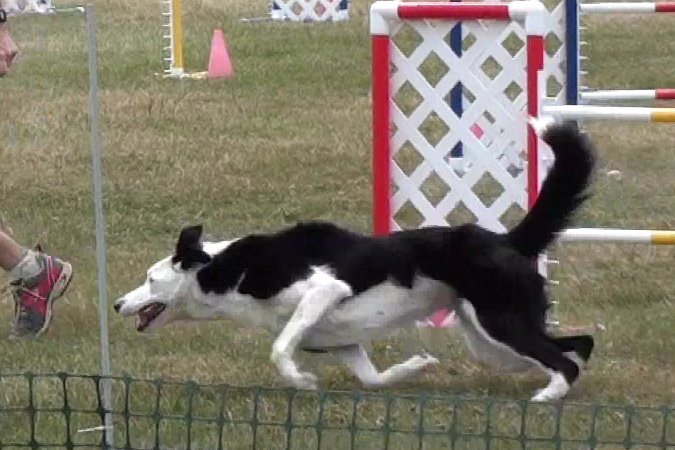
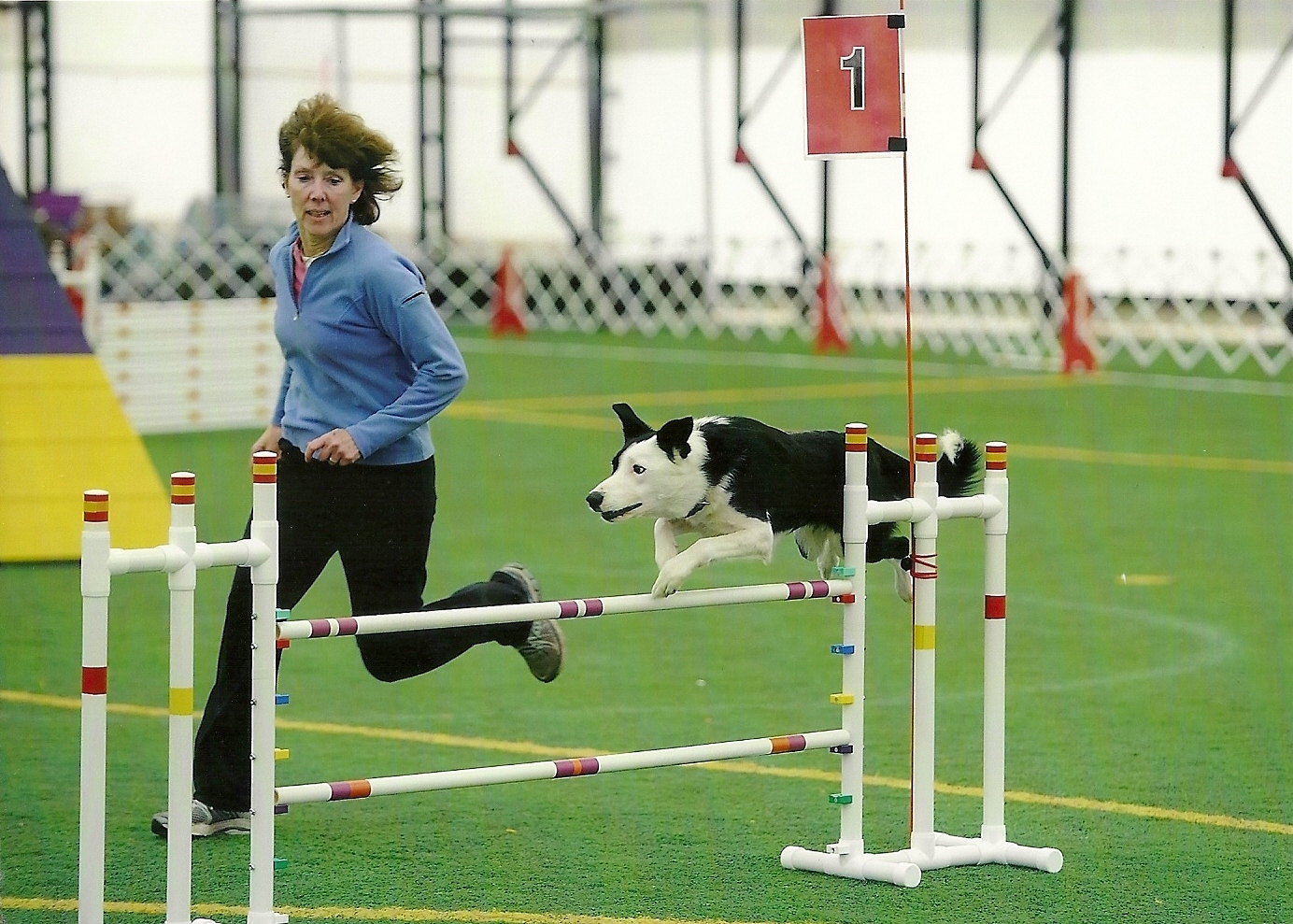
Here is an analysis of a sequence from this past weekend. The video marks the “information zones” between obstacles and what handling cues are used to direct Tai through the sequence. I hope this helps get my point across and encourages you to look at your own video with these concepts in mind. Enjoy and happy training!
I just returned from the AKC National Championships with Breeze and I have to give huge kudos to the AKC for putting on another great event. And kudos to the judges for GREAT courses. From the Warm-up run to the Finals, the course challenges gave competitors lots to think about and held out multiple options for success. It made for interesting running as well as watching.
Among the highlights for Breeze and I were the T2B run where he finished 6th out of 222 dogs. We would have moved up a placement or two, if I had been willing to rip him off the teeter, like so many handlers did. But I felt like that wasn’t a good tactical move so early in the weekend! I was too conservative in Rd 1 JWW of the Nationals Championship…clean, but not a great placement. Then, we had a smokin’ Rd 2 except for when I put him off course in a tricky part of the course. Still, I felt proud of the run because it was a tough course and the rest of it was perfect and surely would have been in the top 6 or so! And I learned a valuable lesson (again) about being more precise about where I will be versus my dog at any spot on course. Then we put it all together in Rd 3, with a pretty perfect run and a 3rd place finish. That placement put us in the Challenger Rd where Breeze and I had a great opening but after Breeze entered the weave poles he slipped on the packed dirt around pole 3 and lost his footing. I think he would have recovered if I had just kept going, but I slowed up and he came out. Bummer, bummer. The rest of the run was good but I know probably not good enough to have won the class. Congrats to Barb Davis and her awesome dog Sketcher, who went on to become the 2013 NAC for the 12″ class. Still, I was so proud of Breeze, who at 9 yrs. old still gives me so much. This was Breeze’s 5th AKC Nationals. At those events, we have made Finals 3 times and Challenger Rd the other 2 times, with many, many placements in classes along the way. Here are Breeze’s T2B and 3rd place run in Rd 3 Hybrid Round. (Photo by Great Dane Photos)
For me, one of the highlights of this year’s event was watching the 26” height class, since I KNOW that Tai and I will be there next year. Wow, Wow, Wow. There is so much talent among dogs and handlers in this height class. It was inspiring and motivating and scary all at the same time. The athleticism of the dogs is astounding and the teamwork between dogs and handlers left me awestruck. To run clean on those courses was something to witness; but for those who won or placed in classes, it meant setting perfect lines throughout the course while the dogs just powered through. And it made me wonder…certainly training and handling are huge factors BUT how much is the individual dog’s raw talent and athleticism contributing to the win? How much is perfect understanding of handler cues? Surely, these big dogs – who spend very little time on the ground – much be absolutely sure of where they are going at each moment, in order to both produce the cleanest lines and use all their power and speed.
This seems to be a time in our sport of dog agility, where handlers are seeking new ways of handling, experimenting with handling cues that will produce the tightest turns and the perfect number of strides throughout the course. Ketschker (sp?) turns and blind crosses abounded at this event. Sometimes these maneuvers produced perfection, sometimes not so much. But I guess you can say that about any handling cue. It’s all about the understanding the dog has at that split second where he needs information about where he is going next. No questions, just power and speed.
That’s why consistency makes so much sense to me. In the “language” , I use with my dogs, if I am running hard, I want my dog to run hard too; if I decelerate– even just a bit, I want my dog to understand that we are turning. If I decelerate to a stop – even for a split second, I want my dog to know that a big turn is coming. If I’m doing a side change, I want my dog to have no doubt about which way we are turning. It’s a series of split second bits of information given by me to my dog and his pure understanding of the cues that will hopefully produce the power, speed and accuracy.
I’m confident that my dogs do understand these cues…so, you will not see me experimenting with “K” turns anytime soon. But it’s fun to watch other handlers get it done a different way!
As for blind crosses, some of what I saw this weekend has me thinking. I saw blind crosses used after the A-frame (Rd 2 and Challenger) and tunnels (Challenger) that produced the needed side change while keeping the dog in full extension – that is, while dogs were going straight or making a very slight turn — and allowing the handler to get ahead in a critical part of the course. On the other hand, I’ve watched enough at Nationals and other places, to be suspicious of blind crosses where the dog is turning significantly on jumps –I can see how the dogs might lose their understanding of shoulder rotation and question what side to come to as their handler rotates her body. I’m having fun watching and trying to figure out what cues the dogs are reading. I’m sure there is a bit of that puzzle I haven’t figured out yet. And for me – who, so far, can execute FC’s without risking knee injury – I see no need to make my dogs think that much.
It’s exciting to see our sport advance and inspiring to watch such great teams pull it all together. Now, if only the snow and ice would leave, I could start my spring training!
Today is Backyard Training blogging day and it got me thinking….What would I do without my Agility Garden? It has adequate space, shade in summer, drains quickly in wet weather, it has grown a full slate of agility equipment over the years and most of all… it’s available whenever I feel the need or desire to train for that 10 minute stretch before dinner or breakfast. Well, except when the snow flies. Even then, I’ve been known to work on drills in the snow.
Added to those benefits, I am free to work on skills my own dogs need in short sessions. I do coursework occasionally, work drills from Clean Run or other sources, or use simple setups to build skills. It would be easy to just walk outside and fiddle around but I have learned to go out with a plan. This week’s goals for Tai are to create a more exciting environment to practice contacts, to work weave entries with speed and to work on tough serpentines at 26″ height.
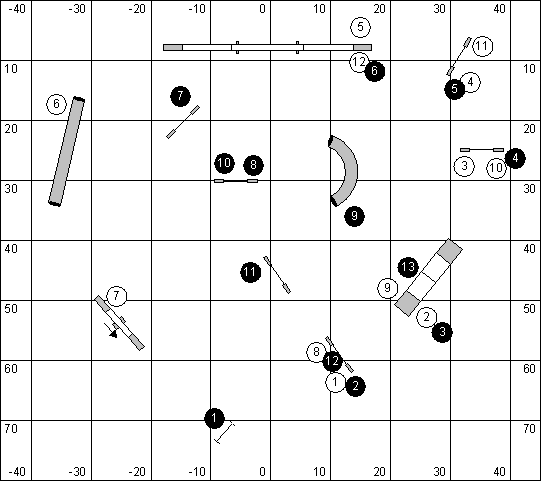
I set up a contact circle as in the diagram below, gathered up good treats, toys, Tai and Breeze. Breeze was my helper to get Tai into a trial like arousal state. Even though there are plenty of distractions in the form of neighbor dogs and wildlife in my yard, it’s not like a trial. This is one disadvantage of backyard training…it can be too familiar for some dogs. You know the one…my dog is perfect at home. So, Breeze executed the contact circle in white letters at full speed with Tai watching from his bed. Then, Tai came out and did the same circle. Quick release on a couple of contacts and the speed was too much for him and he made a mistake by coming off early. Oops, lose your turn and Breeze gets to go again. Then Tai is back out and this time he maintained his self-control and we had a party to celebrate and took a break so I could catch my breath!
In another session, I used the black circles to add some jump drills to the contact circle and get some work at a distance from the dogwalk. This setup has morphed over the week, with the weave poles where the teeter is on the diagram to practice speed into the weaves from the straight tunnel and a line of three jumps between the A-frame and the dogwalk to practice serpentines and 180 degree front crosses after a contact. The wing jumps have been used to practice “walking into serps” to take out some speed and help Tai master this difficult jumping skill.
I bet you can’t guess where Tai’s errors occurred in our last trial? LOL. Looking for other approaches to backyard training? Take a look at the other blog posts on this topic here. Happy training in your own backyard!
Do you know that feeling when you put on a good pair of new shoes? They often feel different, and you THINK about how they feel. Then, over time, as you wear them, they gradually seem to mold to your feet and no longer take up any part of your conscious mind…they feel comfortable and are worn without restraint…almost like they become part of you, and you trust they will do their job. When I run 8 yr old Breeze, that’s how it feels. At our last few trials, we had some spectacular, dare I say, near perfect runs. If you’ll permit me to switch to another metaphor…We ran as a finely tuned, well-oiled and efficient machine and it felt great!
With 2 yr old Tai…even when things go well, I don’t yet have that comfortable old-shoe feeling. This is not surprising when running a 2 year old, fast dog. But the bigger issue, is that Tai is, well, so much bigger than Breeze. With a MUCH longer stride length, it changes the timing of all cues, let me tell you! It means I have to be very conscious of how quickly I may need to cue a turn or be conscious of how much distance I will need to get to where I need to be, of how fast he will take a line and how fast I had better get moving! Way to much thinking going on!
A few weeks ago, I was working on a very difficult, international style sequence with Tai. You really needed to hustle to get into a difficult front cross position. I started out with a new pair of shoes I was testing out for running. Here is how it went with each try: 1) Send and run to get into position; 2) Send and run harder to get into position 3) Get more lateral, send and run really hard to get into position. Not happening. I paused, thought about it and before trying again I changed into my old trusty Ditas and sure enough…I got lateral, ran hard into position and made it…Success! Just that little bit more trust along with a bit more tread made all the difference.
Tai and I are winding down on our first trial season together. We’re working together to develop that old-shoe feeling of trust and sub-conscious connection and timing. No time to THINK on course. Just FOCUS and DO. We’re also polishing our skills into better tread for those old shoes. A little more independence on the contacts and weaves; a little better timing and footwork on my part.
I just re-watched video from our trials from July through October. Some great stuff! His jumping at both 24″ and 26″ looks great. The few mistakes were an occasional bar (you want me to go where??), a refusal here and there (what??), a missed weave entry here and there (you want to to SLOW DOWN while you are running REALLY FAST???), a few self-releases from teeter and dogwalk and the dreaded A-frame misses. He is way too comfortable with a one-stride running A-frame…which has often been too high. Despite a number of attempts, and months of training, to encourage 2 strides with approaches and a variety of stride regulators, he reverts back to one stride.
A few weeks ago I made the decision to switch to a 2 on 2 off behavior on the A-frame. Fortunately I had all the foundation in place as he stops on both the teeter and, since the Spring, on the dogwalk too. I lowered the A-frame a bit, sent him and as he hit his first stride on the frame, said “Target!”. He came to a very nice 2 on 2 off position…like he had been doing it that way all along. So, after over a year of running the A-frame, he has since been perfect in 2on 2off, with all kinds of handling, except for a couple of self-releases, including at a trial just 5 days later. Amazing. Criteria is a wonderful thing. LOL. Now if I can just remember to give the command since all of my shelties have had beautiful running A-frames. So, for now, our running contact adventure is over. No regrets…learned a lot!
Here is a video of some of our runs from late July through October. You’ll see what I mean about the A-frame. Enjoy!
Attitude…”If you don’t like something change it; if you can’t change it, change the way you think about it”. ~Mary Engelbreit
I had a recent couple of trial days with young border collie Tai that sent me into my garden for therapeutic weeding and a glass of wine… and an attitude adjustment. Tai is my first border collie and I’m still learning to live with this unique breed. The Border Collie Rescue web site states: “Training a Border Collie can be like trying to teach a nerdy child that likes to overanalyze everything – it can be frustrating and an exhaustive exercise in patience.” Combine that with his strong herding instinct and I’m sometimes left scratching my head or worse, feeling anxiety and frustration creep up on me.
Here is a simple example. At a recent trial, I was challenged to get him lined up at the start line and pointing in the direction we needed to go…Believe me, at home and away from the ring, we have brilliant line up skills. But on this day (and for the first time at a trial) something kicked in and he picked a point in the middle of the ring to point toward…maybe the judge, not sure but what was for sure is that it wasn’t the direction we were heading. I retried several times and each time he ended up in the same direction. Not sure what to do (the judge would only wait so long), I led out, released him and sure enough, he missed the second jump. This issue was repeated in most of our runs that weekend, although not always with a resulting error. Here’s where the attitude adjustment is important. Yes, it was annoying that after all the training around this particular skill it would fall apart in this situation. Yes, this is a skill that was straightforward for my shelties. But really, he’s a dog, and oh yeah he’s also a border collie. He can’t help how his brain is wired. He didn’t choose my home or this job. I’m asking HIM to play this crazy sport with me and do it my way. So it’s up to me to figure out ways to help him get it right. Because isn’t that my job and my responsibility?
Attitude: “Learn to smile at every situation. See it as an opportunity to prove your strength and ability”. ~Joe Brown
My attitude adjustment is this: Yes, I can have goals that determine our training and trialing, but on each given day, let go of expectations, let go of ego, embrace the dog I have – with all his brilliance and a few quirks – and enjoy the ride. Smile as we begin each run. Laugh when it doesn’t go as planned. Celebrate each effort. Observe and acknowledge the strengths and weaknesses for both of us. Problem solve. Train.
After reviewing the video of that weekend, Tai’s brilliance shown through and I could believe the words of so many of my friends that “Tai looks great!”. Thanks for your support, by the way :-). The next day was much more successful…I think we actually had a “q”, but what I remember most is that I enjoyed the day and sincerely celebrated each run with Tai.
Because I enjoy watching videos, I’ll include one here from an indoor trial the previous weekend…with an error that I did laugh at…something I didn’t expect but as it happened added proofing around tunnels to my training list. You won’t miss it.