Recalls!

This is the second in a series of posts that explore the “little things” that lead to big improvements in agility AND your relationship with your dog.

Everyone understands the importance of recalls in training a puppy. I’m going to make the case in this article that recalls build a great relationship with your dog AND can be a strategic part of your agility training throughout the dog’s career.

Puppy recalls

Why is recall training so important? It teaches the puppy its name, builds a solid foundation for your relationship, develops pack behavior and it encourages the puppy to follow you.
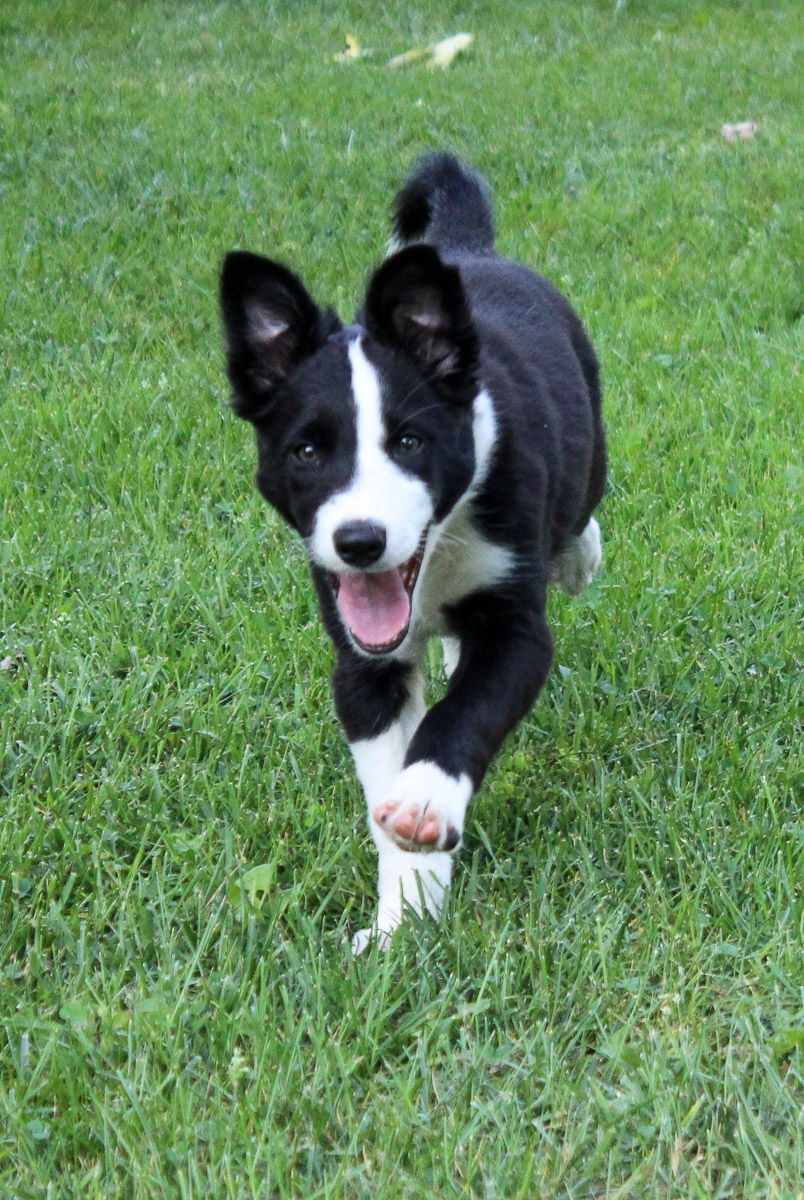
Practicing recalls with a young puppy teaches it that coming to you results in very good things – cookies, toy play, praise, petting. The value of an instant response when the puppy hears its name are many…the most important being safety – think of a dog running toward a busy road. And in everyday life, a great recall is worth its weight in gold.

The perfect recall – that we all strive for! – means that the puppy will come when you call its name (or other cue that you have established) regardless of distraction. It’s another VERBAL CUE that should be taught deliberately, thoroughly proofed and protected!

When approaching your recall training:

Be Deliberate: Include specific recall training in your daily time spent with the puppy.

Build on Good Choices: Allow the puppy to CHOOSE to come to you. My rule of thumb is to give my puppy enough freedom to allow for choices but limit the choices so that there is a very good chance of success and of course, keep the puppy safe.

Be Strategic: Gradually and strategically introduce recall training in different environments and with varied distractions. I raise my chance of success by controlling the environment and level of distraction. Examples of controlling the environment are indoor spaces, fenced outdoor spaces, leashes, long lines, etc. I want my puppy to be rewarded for good choices so I limit his options appropriate for the stage of his training.

Protect the Verbal Recall Cue: I have one ironclad rule in training my puppy’s recall…I only call the puppy’s NAME (my recall cue) when I am 90%+ sure he will come! If my 9 week old puppy is having playtime and is fully engaged with another puppy, I’m not going to call the puppy. If my 16 week old puppy is in the same situation, I might get in close and call him. But if I call once and the puppy doesn’t come, I DO NOT call again. I move closer, use my generic “pup-pup” word, might gently tap the puppy’s butt to get his attention or hold a cookie near his ear, then say his name. I might call “pup-pup” and run away to get a chase response. When the puppy CHOOSES to respond, that response gets an immediate mark (yes or click) and reward. Why not call the name more than once? This is very important! If I say the dog’s name over and over again and he doesn’t respond, I am teaching him to ignore me! The verbal cue of your dog’s name becomes meaningless. Note: This rule goes out the window if safety is involved!

When practicing recalls, only call your puppy ONCE and mark the CHOICE the puppy has made to come to you.

I am not going to go into detail about all the recall games I play with my puppies because there are tons of online resources on this topic. Instead, I want to draw the dots between this early training and success in other aspects of your future agility star.
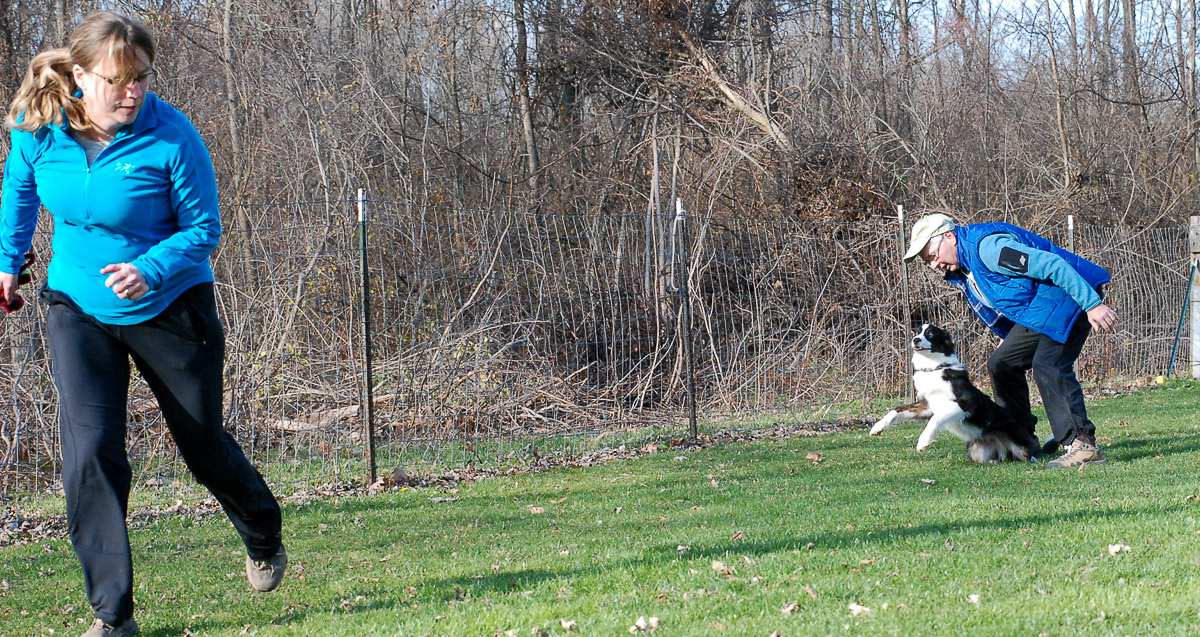
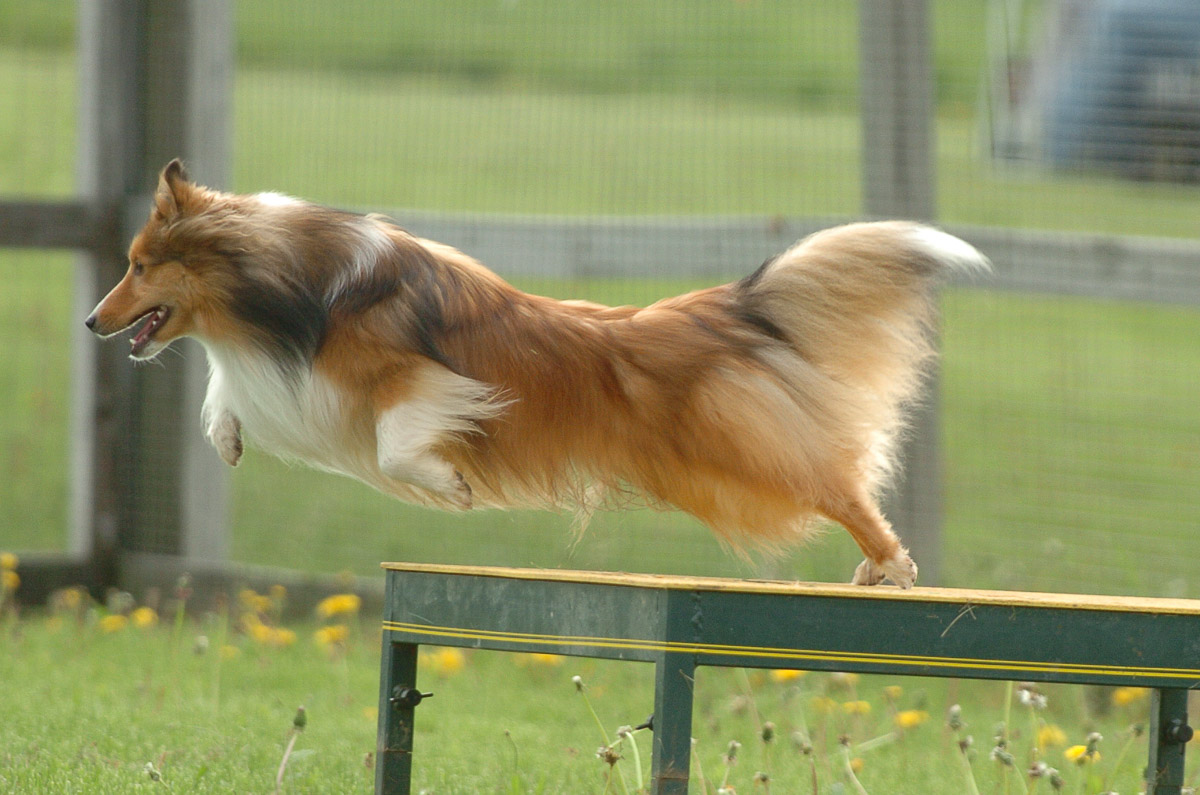
Photo by Dianne Spring

Recalls for Agility and Life

I incorporate a lot of chase games into my recall training. Running away after calling the puppy’s name (or release cue) builds drive to come to me quickly. I look over my shoulder as I move away and reward the puppy when he catches up helping him learn to come up on the side that is facing him. This is the beginning of my agility handling training!

It’s a good idea to hold your reward in the opposite hand, like Barb is doing, so that the dog is coming to YOU, not a dangling toy or obvious food reward. Switch the reward to the dog-side hand as the dog reaches you.

What I do when the puppy gets to me on the recall is used to introduce important concepts of agility handling. Essentially, I want my puppy to learn: 1) Always come up on the side that is facing you 2) When I run, you run; 3) When I stop, you stop; 4) When I turn, you turn. These types of lessons are perfect for restrained recalls (where another person holds the puppy) and the puppy is released on the call of its name, not the release cue. As the puppy matures and develops impulse control, the recalls can start with a stationary behavior (sit, down, stand) and the use of a separate release cue (see the first post in this series).

I bucket my recalls like this:

When I run, you run (acceleration): Lead out in “game on” position (like Barb is doing in the picture above). Release and start running. Throw the reward ahead in a straight line as the dog gets near me. The puppy has learned that as long as I keep running he should too. The verbal “GO” can be added into this recall.

When I stop, you stop (deceleration): Lead out in “stationary” position. Release the puppy and stand still. Reward when the puppy reaches me. The puppy has learned that he should “dig in” and stop when I am stationary. There are several variations of this type of stationary recall, including running first and then stopping. I can either be facing in the same direction of the puppy or I can turn and face the puppy. The verbal collection cue (e.g. “dig-dig”) can be added into this recall.

When I turn, you turn: Lead out in “game on” position. Release and start running. As the puppy gets near me, I turn away from the puppy, tapping my leg to keep the puppy on the recall side and saying his name (or bypass cue) to keep him with me. Effectively executing a post turn or teaching the beginning of a bypass cue.

Come up on the new side: Lead out in “game on” position. Release and start running. As the puppy gets near me, I turn into the puppy, effectively executing a front cross. Or, way before the puppy reaches me, I turn away from the puppy and present a new side, effectively executing a blind cross.

With these recalls, I have taught the puppy all the handling elements that he will respond to on course! For some of these recalls, there is more foundation work separate from the recalls, like teaching the dog about reinforcement zone and working separately on circle work. But that is for another post. All of these recalls can be adapted to either wing work or one/two jump work as your dog progresses.

Revisit these recalls throughout the dog’s career as a great way to reinforce early lessons and warm up both you and your dog.

The main message of this post is to FREQUENTLY revisit your recalls throughout your dog’s career. You will continue to put value into your relationship, your dog’s response to your most basic handling cues and practice your stays. What better way to warm-up both you and your dog before training than to strategically practice your recalls (and circle work)? Make it a habit and you will keep your dog’s response to your acceleration, deceleration and turning cues sharp throughout his career.
The Release Word – the first step toward impulse control

This is the first in a series of posts that explore the “little things” that lead to big improvements in agility AND your relationship with your dog.

In this post, I’m going to make the case that teaching a verbal release word is one of the first things you should teach your puppy and is critical to building impulse control and therefore teaching stationary behaviors like a sit-stay or independent stop on a contact.

When do I start?

Right away! When I bring a puppy home and know its comfortable in its new environment, we play games that include a lot of physical play and tons of reinforcement with food, toys and interaction with me. During these play sessions I introduce my release word. Usually it goes like this…play, play, play…PAUSE. Wait for a behavior….Often the puppy will sit but it’s ok if the puppy just pauses too. I then immediately say the word (without moving) and immediately re-engage with the puppy. As I build on those experiences and get the puppy to offer stationary behaviors like sit, down, stand, stay in crate, wait at door, etc., I consistently use my release word. I choose a word that I don’t use often in everyday life. For a while now, I’ve used the word “Break” and it seems to work well. But any word that isn’t used often in everyday speech and doesn’t sound like your other planned verbal skills will work.

For a very young puppy, the “wait for release” might be just a second or two. But the experience of and reinforcement for choosing to wait until the verbal cue is given is HUGE! Once the word is given and the puppy “breaks”, it is immediately reinforced with a cookie, a chase game, engagement with the toy or other fun activity. That’s right…the puppy is rewarded for “breaking” but ONLY when it hears the magic word! This is great practice for building impulse control!

The release word is a verbal cue

Verbal cues are all the rage in agility these days. Do you think of your release word as a verbal cue? You should! A release word is the first verbal cue I teach my puppies and as with other verbal cues, I work toward building an understanding of the cue independent of my motion or other physical cues. After all, on an agility course I need to be moving while the dog is stationary as I lead out or run past the dog who has stopped at the end of the contact. I can make a case that if you are going to teach – and proof – just one verbal cue, the release word should be it. Other than the dog’s name of course!

Why is teaching verbal cues so hard? Dogs are naturally way more tuned into physical cues and motion than they are to verbal cues. Without a clear understanding of the verbal release cue, the dog will be looking for ANY physical cue to end the stationary behavior. You might imagine the dog guessing…Do I leave when she takes a step? Can I leave when she flicks her hand? When she leans away? When she stops and then starts again? The tension builds the longer this guessing game goes on until the dog is shifting around or breaking his stay. It is **very** important that you do not consistently pair physical motion with your verbal release cue. At first, isolate the release word from any motion, then add “nonsense” motion to help the dog understand that the release is on the WORD, not the motion. It is a good idea to video some of your training sessions so you can verify that you have isolated the verbal cue.

Not having a well understood verbal release cue makes it very difficult to put any kind of duration or independence on stationary behaviors like a sit-stay or target behavior on contacts, no matter how often you reward in place. For some high-drive dogs, it makes it almost impossible. For softer dogs, the confusion of not knowing when to leave takes a little bit of their spark away.

What about rewarding in place?

When building duration in stationary behaviors I will reward in place but I’m careful to maintain the understanding that the behavior ends when I give the verbal release cue, not when I stop delivering cookies.

More than one release cue?

You can definitely have more than one release cue. My release word means – end the current behavior and come to me OR do the next behavior that I’ve cued. As I add other well trained verbal cues, I can use them as release cues. “Get it” – to release to a toy; or “Down” from a “Sit”. Or cue an obstacle like a jump (“Hup”) or “Tunnel” from the start line or a stopped contact.

Keep the game going

I like playing little games with my dogs into their adulthood that incorporate foundation skills. These games are engaging, low impact and reinforce necessary skills. I’ve included a short session with Nick at the link below. Here, I apply a mental model I call the “Even When” game. Can Nick maintain his sit or down stay and wait for the verbal release even when I am flapping my arms? Even when I stop and start again in my lead-out? Even when I give a different word? Even when I run hard? Even when I throw a ball in front of his face? As a mature dog, Nick is pretty good at this game. For a puppy, the “even when” criteria are introduced gradually, allowing the pup to be “mostly” successful. A little failure is necessary to learning, after all!

Fun with the Release Cue

I’d love to hear your thoughts on this topic! Does it make sense? Do you think this approach could help your dog develop impulse control more easily and streamline your training?

Happy Training!

Taking the long view

Needless to say, like all of us, my September 2020 is different than I had planned for, hoped for, or expected. Summer vacations, family get-togethers, agility events, agility workshops, social gatherings with friends…all canceled or strictly limited due to the pandemic. While it would be easy to get depressed, pessimistic, grouchy or super stressed (and all of those emotions have visited me in short bursts), I’ve been largely successful in nurturing a positive attitude and a growth mindset as I wait for the new normal to kick in.

Maintaining gratitude hasn’t been as hard as you might think as my family is healthy, my income is secure, my community is responsible in following the “pandemic” rules and I’m hopeful that this will all be over at some point relatively soon due to the brilliant work of our medical researchers.

I’ve taken this gift of time to get better at photography, build a new website for an environmental non-profit Genesee RiverWatch (I’m a board member), start a vegetable garden, explore and commit to an online workout program (12 weeks and counting!), and unearth my bicycle to take advantage of the wonderful biking/hiking trail that is just minutes from my home.

Through all this, my dogs have both kept me sane and produced heartache. We said good-bye to our beloved Sheltie Breeze on July 15th. At 16-1/2 yrs old, he had lived a long good life. While his last year was a little tough, mostly he had a great quality of life, spreading joy to anyone he met – who said shelties are shy and reserved? Because of Breeze’s talent for agility, he provided me with all kinds of adventures, long-lasting friendships and travel to places I would probably never had visited. Czech Republic anyone?

Border collie Nick and I were having fun doing agility as the weather improved after a late spring but recurrent front-end lameness starting in mid-June brought all that to a halt by early July, just as he turned 5 yrs old. After a mid-August trip to Veterinary Orthopedic & Sports Medicine (VOSM), I knew we were in for a new, unwanted and unexpected adventure. At the end of September, Nick will have PRP/Stem cell injections in his left carpus and both shoulders along with left shoulder arthroscopy. He’ll be in hobbles for 12 weeks (!) and then rehab will follow. I don’t know of an acute injury that caused the issue, but the diagnostics indicate that the carpus had been sore for a while and the shoulder was secondary. Perhaps I would have picked up on that if I had done my regular rehab vet checks that were canceled due to the pandemic. Nick was certainly good at hiding his discomfort. It’s so sad to think of a young dog missing out on 6+ months of “action”. And yet, and yet – a big lesson to learn here – he remains a very happy guy!

Which brings me to Tai. Tai is 10-3/4 yrs old, retired from agility at age 9, and we are trying new things. We are working on Nosework skills with awesome instructor Julie Symons and he has had a few herding lessons. He’s very good at scent work but I’m not sure about herding :-). He has a long history of “don’t chase things” and I worry about him getting hurt. We’ll stick with it for a while and see what happens.  Just being able to do things with him at this age is a gift.

So what is next?  I’m taking the long view. I’m hoping to dip my toe into teaching again soon, so stay tuned for that news.  Surely, Nick’s rehab will nearly be a full time job and I’m hoping with the great team of Dr. Canapps at VOSM and Thera-vet that we’ll get where we need to be for an active lifestyle early in 2021. I’ll enjoy Tai’s elder years and who knows, maybe a puppy will be in our future. We’ll keep on plugging along with the conviction that 2021 will be a better new normal.


Nancy Gyes Workshops March 13-15

Nancy Gyes will be in Rochester, NY for workshops March 13-15, 2020! Nancy is the AKC World Team Coach, co-owner of Power Paws Agility in California, author and dog trainer extraordinaire.  Here is the schedule:

  • Friday Morning – International / Premier Drills & Skills
  • Friday Afternoon – International / Premier Sequences
  • Saturday Morning – Got Foundation? – For older puppies (8 months plus) and any age that wants to revisit foundation skills. Tunnels, wings or low jumps only.
  • Saturday Afternoon – Masters Handling
  • Sunday Morning – International / Premier – Skills and Sequences for the most efficient path
  • Sunday Afternoon – Masters Handling

Note that each of the half day sessions will be limited to 8 working spots.  Auditors are welcome too.  The workshops will be held at Five Points Training in Rush, NY, just south of Rochester.

Payment in full will secure your spot. I will not cash checks until 2 weeks prior to event. Working spots are not refundable after February 12th unless the spot can be filled with another working team (I will keep a wait list).

NANCY GYES SEMINAR Flyer 2020 March

Spring Classes at Game On! Dog Training

Happy Spring!
I know it doesn’t feel much like Spring here yet in the Northeast but it will come eventually so let’s talk dog agility training.  With limited winter training opportunities have you built up a list of skills you want to work on – either handling skills or dog training skills?  I certainly have!  As an instructor, I would like to help get you off to a good start.

Game On! Spring Class information

Online classes

1) Nick’s Boot Camp – A jumping program for technical sequences. This course has 6 lessons with 3-4 exercises in each lesson designed to give you the foundation blueprint for achieving efficient and safe turns, even on technical courses.  You will build your dog’s understanding of how to physically manage turns on technical sequences including wraps, threadles, backsides and serpentines; and at the same time you will build the physical and verbal cues that you will use as a handler to prepare your dog for the turns.

2) 2on2off Contact Behavior – This course describes a step by step method of teaching a reliable 2on-2off behavior for use on the dogwalk, A-frame and teeter in dog agility. There are 6 lessons with multiple parts per lesson. Whether you are starting out a puppy or need to re-train an adult dog or just clean things up a bit, this course will help.

Online classes

Outdoor classes start in May – near Rochester, NY.

Check it out details here!

1 2 3 4 15